


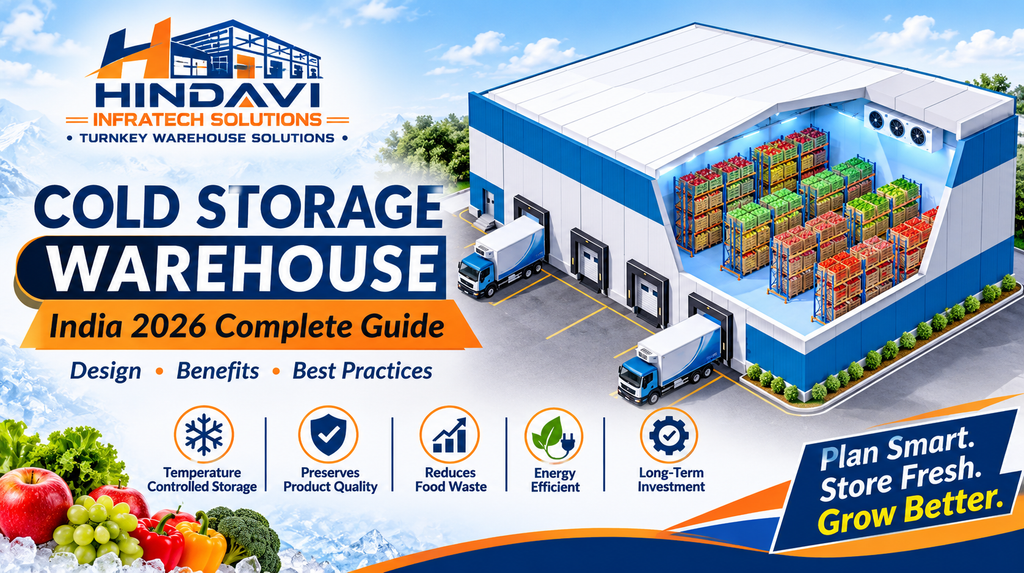
Quick Summary
- A cold storage warehouse is a building that holds a set temperature, and often humidity, for perishable goods such as fruit, dairy, frozen food and medicines.
- Government data shows India had 8,815 cold storages with about 40.22 million tonnes of capacity in June 2025. Roughly three-quarters of that space is used for potatoes.
- The real gap is in the right kind of space: multi-temperature stores, pack houses near farms, pharma storage and stores close to cities, not only in total tonnes.
- Cost depends on temperature, size, insulation, refrigeration and automation. Treat any published rate as a starting point.
- Capital subsidies of 35% (higher in some regions) exist for horticulture cold storage, but they are worked out on a government cost norm and usually cover less than the headline percentage of your real cost.
- Good design saves more over 15 years than a cheaper build saves on day one, because power is the biggest running cost.
Introduction
Most problems in a cold storage warehouse are decided before the first panel is fixed. A dock that lets warm air rush in, a floor that heaves in a freezer, an evaporator placed so that one corner never reaches the set temperature, or a roof that cannot take the load of new equipment are all design mistakes, and they are expensive to correct once the building is running.
This guide is for investors, operations heads, food and pharma businesses and project managers who are planning a cold storage warehouse in India. It covers what a cold store is, where India stands, how to design one, what it costs, how subsidies work, which approvals matter and how to run it well. We are Hindavi Infratech Solutions, an Ahmedabad-based company that builds PEB warehouses and industrial buildings, so the guide is written from the building side, and we say clearly where refrigeration specialists need to lead.
What Is a Cold Storage Warehouse?
A cold storage warehouse is a building made to keep goods at a controlled temperature for days, weeks or months. Unlike an ordinary warehouse, every part of it works against heat: the insulated walls and roof, the sealed doors, the floor, the dock, the refrigeration plant and the airflow inside.
The difference shows up in four places.
- The envelope: insulated panels, joints and vapour barriers that keep heat and moisture out
- The refrigeration plant: compressors, condensers and evaporators sized for the load
- Airflow and layout: where cold air enters, how it moves around the stock and how racking is placed
- Monitoring and compliance: temperature loggers, alarms, records and hygiene systems
Get one of these wrong and you either waste power, spoil stock or fail an audit.
India’s Cold Storage Market: What the Numbers Say

Official figures give a clearer picture than the round numbers often repeated online.
- As of 30 June 2025, India had 8,815 cold storages with a combined capacity of 402.18 lakh tonnes, or about 40.22 million tonnes, according to government data.
- A 2026 FICCI and Grant Thornton Bharat report says this is about 84% of the 48 million tonnes the India Cooling Action Plan envisages for 2037-38.
- The same report says about three-quarters of capacity is used for potatoes, and more than half is in Uttar Pradesh and West Bengal. Gujarat is among the leading states by capacity.
What this means for you: India does not simply need more cold rooms. It needs the right ones in the right places. Stores for fruit, vegetables, dairy, frozen food and medicines, pack houses close to farms, and facilities near cities and ports are where the shortage is felt. If you are planning a cold storage warehouse, think about your product and your location before you think about tonnes.
A note on older figures: some guides still say India has about 32 million tonnes of capacity and a gap of 8 million tonnes. Those numbers are older than the June 2025 data above. Use the latest official figures when you write a project report.
Types of Cold Storage Warehouses
The temperature you need decides the insulation, the refrigeration and the layout. These are typical ranges. Your refrigeration designer will fix the exact figures for your product.
| Type | Typical temperature | Common use | Typical PUF or PIR panel thickness* |
|---|---|---|---|
| Pre-cooling and ripening | About 2°C to 18°C, depending on the produce | Fruit and vegetables after harvest, bananas, mangoes | 60 to 100 mm |
| Chiller store | 0°C to 8°C | Dairy, fresh produce, fresh meat, vaccines | 80 to 100 mm |
| Frozen store | About -18°C to -25°C | Frozen food, seafood, ice cream | 120 to 150 mm |
| Blast freezer or IQF | About -35°C to -40°C | Rapid freezing of meat, seafood, ready meals | 150 to 200 mm |
| CA or MA chamber | About 0°C to 2°C with controlled gases | Apples, pears and other long-term fruit storage | As per the designer |
| Pharma cold room | 2°C to 8°C, or controlled room temperature | Medicines, vaccines, biologicals | As per the designer and the validation plan |
*Thickness figures are commonly used industry values, not a rule. Wall height, ambient heat, door traffic and the product decide the final choice.
Many new buildings are multi-temperature, with chiller, frozen and ambient areas under one roof, because one operator often serves several customers with different needs.
Designing a Cold Storage Warehouse
1. Site and access
Choose a plot with reliable three-phase power, good road access for refrigerated trucks and water for the refrigeration plant. Avoid low-lying land that floods. For farm produce, being close to the farm matters more than being close to the city. For city distribution, being close to your customers matters most.
2. The structure
Many cold stores use a PEB steel shell with an insulated panel envelope or insulated panels fixed to a steel frame. The structure must carry the roof, the panels, the refrigeration equipment, any mezzanine and the loads from racking and forklifts. Because the building has to stay sealed, small movements and misaligned joints matter more than in a normal shed. Our PEB construction team plans these points with your refrigeration engineer before the drawings are final, and our structural steel fabrication work supports the frame.
3. Insulated panels
PUF and PIR panels are the usual choices. Ask for the thermal performance, the density and the fire test certificates for the exact panel, and check how the joints, corners and penetrations are sealed. A good panel with poor joints still leaks heat.
4. The floor
Floors must carry racking and forklifts and stay dry and level. In freezers, the ground under the floor can freeze and lift the slab, a problem known as frost heave, so freezer floors need under-floor insulation and heating or ventilation. This is a design decision made at the start, not a repair made later.
5. Docks and doors
Warm air entering at the dock is one of the largest hidden loads. Dock shelters, sealed doors, air curtains or strip curtains and a short door-open time reduce this. Plan enough docks so trucks do not wait with doors open.
6. Airflow and layout
Evaporator position, air throw and aisle width decide whether every pallet reaches the set temperature. Racking must leave clear air paths, and stock must not block the evaporator. Layout drawings should show airflow, not just racks.
7. Power backup and monitoring
A power failure can ruin a full store in hours. Plan a generator or backup supply, temperature loggers in every chamber and alarms that reach a person, not only a screen.
8. Fire safety
Insulation materials, cables and refrigerants all affect fire risk. Ask for fire test certificates for panels, plan exits and detection, and check the fire NOC requirement for your building.
Choosing the Refrigeration System
Refrigeration is a specialist field, and the plant is one of the largest cost heads. Your refrigeration engineer should choose it. We coordinate the building with them.
| Refrigerant | Strengths | Points to weigh |
|---|---|---|
| Ammonia | Very efficient at large scale, low running cost | Toxic, so it needs safety systems and trained operators |
| Synthetic refrigerants (HFC and HFO) | Common in small and medium stores, widely serviced | Environmental impact and future regulation vary by type |
| CO2 | Natural refrigerant, good at low temperatures | Higher system cost and a need for specialist service |
| Ammonia with CO2 | Combines efficiency with lower ammonia quantity | More complex to design and commission |
Whatever the refrigerant, ask for variable-speed compressors, efficient evaporator fans, good controls and a service plan.
Cold Storage Warehouse Cost in India
There is no single price, because temperature, size, insulation, refrigeration and automation vary so much. Published 2026 guides put a 100 tonne multi-chamber cold store at roughly ₹65 lakh to ₹1.2 crore, and smaller single-chamber stores lower than that. Larger and colder projects cost far more in total.
What drives the cost
- The temperature: colder means thicker insulation and bigger refrigeration
- The size and the number of chambers
- The structure: PEB or RCC, height and span
- Insulated panels, doors and dock equipment
- Refrigeration plant and controls
- Flooring, including under-floor heating for freezers
- Racking or automation
- Electrical work, backup power and monitoring
- Fire safety and approvals
- Location and the steel and panel prices on the day of order
Running cost
Electricity is usually the largest running cost, followed by maintenance, staff, insurance and compliance. Good insulation, tight docks, efficient equipment and disciplined door use lower the power bill for the whole life of the building. When you compare quotes, compare the expected power use as well as the build price.
For the building shell, our PEB structure cost per sq ft guide explains the cost heads of a PEB, and our warehouse construction cost guide for Ahmedabad covers the ordinary warehouse. A cold store costs more than both because of the insulation, refrigeration and flooring.
Subsidies and Finance
Several schemes support horticulture cold storage. The details change, so confirm them on the official websites before you plan around them.
- Mission for Integrated Development of Horticulture (MIDH): a credit-linked, back-ended capital subsidy for cold storage up to 5,000 tonnes, applied for through the State Horticulture Mission. The rate is 35% of project cost in general areas, and higher in north-eastern, hilly and scheduled areas.
- National Horticulture Board (NHB): a similar capital investment subsidy for larger cold stores and CA stores. The rates are revised from time to time, so check the latest NHB circular.
- PMKSY integrated cold chain scheme: a grant for integrated cold chain projects of up to ₹10 crore each. It is meant for a full chain, for example a pack house with storage and transport, and not for a standalone cold store. Check its current status before you plan around it.
- Agriculture Infrastructure Fund and bank loans: credit support may be available for eligible projects.
Read the fine print
- The subsidy is worked out on a government cost norm per tonne, not on your actual cost. It usually covers less than the headline percentage of what you spend.
- It is back-ended, which means you fund the project first and receive the subsidy after.
- Many schemes require approval before work starts. Apply before you begin construction.
- Schemes mainly cover horticulture products. Check whether your product and your type of store are eligible.
Approvals and Compliance
The approvals depend on what you store and where you build.
- Food: an FSSAI licence for your kind of business, with hygiene and temperature records
- Pharma: the licences and good storage and distribution practices that apply to your products
- Fire safety: fire NOC and fire protection as required for your building
- Building and factory approvals: building plan approval, and factory and pollution board approvals where applicable. In GIDC estates, plans go through GIDC. Elsewhere they go to the local authority. Our industrial shed construction page has more on GIDC approvals.
- Refrigerant safety: safety systems and training, especially with ammonia
Check the current rules for your plot and activity with the authorities. Do not rely on a general guide for your final approvals.
Running a Cold Storage Warehouse Well
A good building still needs good habits.
- Log temperatures in every chamber and review them daily, with alarms that reach a responsible person
- Keep doors closed and limit the time they stay open during loading
- Use FIFO or FEFO so older or shorter-life stock moves out first
- Leave clear air paths around evaporators and between pallets
- Maintain on schedule: defrost cycles, door seals, fan motors, compressors and the generator
- Train staff in hygiene, safe handling and what to do in a power failure
- Inspect the envelope for damaged panels, torn seals and ice build-up, and fix them early
- Track power use per tonne stored, so a rise warns you of a problem
Common Mistakes to Avoid
- Choosing a refrigeration plant before the building design is fixed
- Forgetting under-floor protection in a freezer
- Too few docks, so trucks wait with doors open
- Ignoring joint quality in the panels
- Underestimating power cost and backup power
- Planning without room for expansion
- Assuming the subsidy covers the full headline percentage of the cost
- Hiring separate vendors with no one responsible for the whole system
How to Choose a Cold Storage Builder
Ask every builder these questions.
- Who designs the building, and who designs the refrigeration? Are they coordinated?
- Which panels do you propose, with what test certificates and joint details?
- What is included and excluded in the quote, including floor, doors, dock equipment and electrical work?
- Who is responsible if the building and the refrigeration plant do not work together?
- Can I visit a completed project and speak to the owner?
- What are the timeline milestones and the warranty terms?
- What support do you give after handover?
See also our guide to choosing an industrial shed contractor and our guide to comparing PEB companies in Ahmedabad, since most of the checks apply to cold stores too.
How Hindavi Infratech Solutions Can Help
We are a young Ahmedabad company, founded in 2025. We design and build PEB warehouses and industrial buildings, and we plan cold storage shells with your refrigeration engineer so that the structure, insulated envelope, floor and dock work as one system. Our quotes list what is included and what is not, and we encourage you to ask for drawings, references and specifications and to compare us with others. See our warehouse construction services and our turnkey project solution.
Frequently Asked Questions
What is a cold storage warehouse?
It is a building that keeps goods at a controlled temperature, and often humidity, using insulated walls and roof, sealed doors and a refrigeration plant. It is used for fruit, vegetables, dairy, meat, seafood, frozen food and medicines.
How many cold storages are there in India?
Government data shows 8,815 cold storages with about 40.22 million tonnes of capacity as of 30 June 2025. About three-quarters of the capacity is used for potatoes, and more than half is in Uttar Pradesh and West Bengal.
How much does a cold storage warehouse cost in India?
It depends on temperature, size, insulation, refrigeration and automation. Published 2026 guides place a 100 tonne multi-chamber store at about ₹65 lakh to ₹1.2 crore. Ask builders for an itemised quote, and compare the power use as well as the price.
What panel thickness is used in a cold storage warehouse?
Common industry values are about 80 to 100 mm for chiller rooms, 120 to 150 mm for frozen stores and 150 to 200 mm for blast freezers. Your designer will fix the final figure from the temperature, ambient heat and wall height.
Is there a subsidy for cold storage in India?
Yes, for horticulture cold storage. MIDH supports stores up to 5,000 tonnes and NHB supports larger ones, with a rate of 35% in general areas and more in some regions. The subsidy is back-ended and worked out on a government cost norm. Check the current rules on the official websites.
Which refrigerant is best for a cold store?
There is no single best choice. Ammonia suits large stores, synthetic refrigerants are common in small and medium stores and CO2 or ammonia with CO2 suit projects that want natural refrigerants. Your refrigeration engineer should choose based on size, temperature and safety needs.
Why does a freezer need a special floor?
The ground under a freezer can freeze and lift the slab, which cracks the floor. Freezer floors therefore need under-floor insulation and heating or ventilation, planned from the start.
Can a cold storage warehouse be built with a PEB structure?
Yes. Many cold stores use a PEB steel shell with insulated panels. The structure must be designed for the extra loads and for tight sealing. Read our PEB construction company page for how we approach it, and our guide on what a PEB shed manufacturer does.
Sources and Further Reading
- Press Information Bureau, Government of India: cold storage capacity data as of 30 June 2025, and the Integrated Cold Chain and Value Addition Infrastructure scheme (static.pib.gov.in/WriteReadData/specificdocs/documents/2025/nov/doc2025114684601.pdf)
- FICCI and Grant Thornton Bharat: India’s Cold Chain Infrastructure: From Storage to a Chain (reported by Business Standard, October 2026)
- National Horticulture Board and Mission for Integrated Development of Horticulture: capital investment subsidy guidelines (nhb.gov.in)
- Food Safety and Standards Authority of India: licensing and hygiene requirements (fssai.gov.in)
Related Reading
- PEB Structure Cost Per Sq Ft in India: Latest Trends, Pricing, and Benefits
- Warehouse Construction Cost in Ahmedabad (2026)
- What Is a PEB Shed Manufacturer?
- PEB Companies in Ahmedabad: How to Find, Compare and Choose the Right One
Planning a Cold Storage Warehouse? Talk to Us
Tell us what you will store, the capacity you need and your location. Contact Hindavi Infratech Solutions and we will review your requirement and help plan the building with your refrigeration team.
Contact: +91 88665 38833 | hello@hindavi.co.in
2 Responses