


Most online brands begin the same way. A few boxes in a spare room, a roll of tape, and a promise to ship by tomorrow. It works for a while. Then a festive sale lands, orders triple overnight, and nobody can say for sure which size is left or which parcel has gone out.
That is the point where a storage space has to become a system. This guide explains what an e-commerce warehouse is, how it runs from the first delivery to the last return, which technology sits behind it, and what it costs in India today. We are Hindavi Infratech Solution, and we build the sheds, PEB structures and structure steel frames that these facilities live in, so you will also see the building side of the story that most guides leave out.
What Is an E-commerce Warehouse?
An e-commerce warehouse is a facility designed to store, organise and ship products that are sold through online channels. Its job is not just to hold stock. Its job is to turn each customer order into a correct parcel on a courier’s truck, quickly and without mistakes.
A traditional warehouse usually waits for goods to be called off in bulk. A modern e-commerce warehouse works at a different rhythm. It handles many SKUs, thousands of small orders, constant stock movement, and a steady flow of returns. It also shares live stock data with your website and marketplaces, so what a customer sees online matches what is on the shelf.
The typical activities inside one include:
- Receiving inventory and checking quality
- Storing stock in marked locations
- Tracking inventory in real time
- Processing online orders
- Picking, packing and labelling
- Dispatch to courier partners
- Handling returns and reverse logistics
The difference becomes obvious as a brand grows. What worked at 20 orders a day starts to break at 200.
How Does an E-commerce Warehouse Work?
Think of it as one continuous chain: supplier, receiving, storage, customer order, picking, packing, dispatch, delivery, and returns. This chain is the heart of online order fulfillment, and each link has its own job.
1. Receiving Inventory
Goods arrive from manufacturers, suppliers or another location. The team counts them, checks for damage, and records them against the purchase order. Catching a short delivery or a broken carton here is far cheaper than discovering it after a customer complains.
2. Inventory Storage
Every item gets a defined location. Layouts are usually planned by SKU, category, size, demand, handling needs or storage conditions. Fast sellers are kept close to the packing area so that pickers walk less. Smart e-commerce storage solutions such as bins, pallet racks and mezzanine floors help use the same floor area far better.
3. Inventory Management
Good e-commerce inventory management answers a few simple questions at any moment. What is available? Where is it? What is selling fast? What is about to run out? What is reserved for orders already placed? And which returns can be sold again? When these answers are wrong, brands face stockouts, overselling and dead stock.
4. Order Processing
When a customer buys from your website or a marketplace, the order must reach the warehouse without delay. E-commerce order processing converts that order into a pick task. For brands that sell on several platforms, this is where things get complicated, because orders arrive from many places at once.
5. Picking
Picking means collecting the right item, in the right quantity, for the right order. Methods range from simple single-order picking to batch, zone and wave picking. Well-planned warehouse picking and packing can lift productivity far more than adding extra staff.
6. Packing and Labelling
Picked items are checked, packed in suitable material, and labelled with the courier slip and any invoice or branding. Right-sized packaging reduces damage and also trims shipping cost.
7. Dispatch and Shipping
Parcels are sorted by courier partner and handed over at the dock. Many warehouses work with more than one courier, choosing based on pincode, service level and delivery history.
8. Returns and Reverse Logistics
Returns are part of online selling, not an exception. Returned goods are received, inspected and recorded. Sellable items go back to stock, and damaged ones are separated. A clear returns process protects both margin and customer trust.
E-commerce Warehouse vs. Traditional Warehouse
Both store goods, but they are built for different work.
| Factor | Traditional Warehouse | E-commerce Warehouse |
|---|---|---|
| Primary focus | Storage and bulk movement | Storage plus frequent order processing |
| Order size | Large, bulk orders | Small, individual orders |
| Picking | Pallet or case level | Frequent SKU-level picking |
| Packing | Usually standard | Order-specific, often branded |
| Sales channels | Retail, wholesale, B2B | D2C website, marketplaces, quick commerce, B2B |
| Inventory visibility | Varies | Mostly system-driven and real time |
| Returns | Limited | A core daily function |
| Delivery expectation | Scheduled | Fast and customer-focused |
| Technology | Depends on the site | Linked to WMS, OMS and shopping platforms |
The real difference is not the building. It is how the whole place is organised around e-commerce order flow.
What Are the Main Operations in an E-commerce Warehouse?
Strong e-commerce warehouse operations bring several linked activities together:
- Receiving and putaway: checking, recording and shelving incoming stock.
- Inventory control: tracking counts, locations, movement and replenishment.
- Picking: collecting items for each order.
- Packing: protecting and labelling parcels.
- Dispatch: handing shipments to couriers.
- Returns processing: inspecting and restocking returned goods.
- Order visibility: following each order from placement to delivery.
The more SKUs and orders a brand handles, the more important it is to write these steps down and repeat them the same way every day. Good e-commerce warehouse management is mostly consistency.
What Technology Is Used in an E-commerce Warehouse?
Online selling produces a lot of live data about stock and orders. Technology is how a warehouse keeps up with it.
1. Warehouse Management System
A warehouse management system (WMS) controls day-to-day activity inside the building: where stock goes, which item to pick next, and how much is left. It replaces guesswork and loose spreadsheets with one reliable record.
2. Order Management System
An Order Management System (OMS) collects orders from every sales channel in one place and routes them to the right location. It is especially useful when a brand sells on its own site and on several marketplaces together.
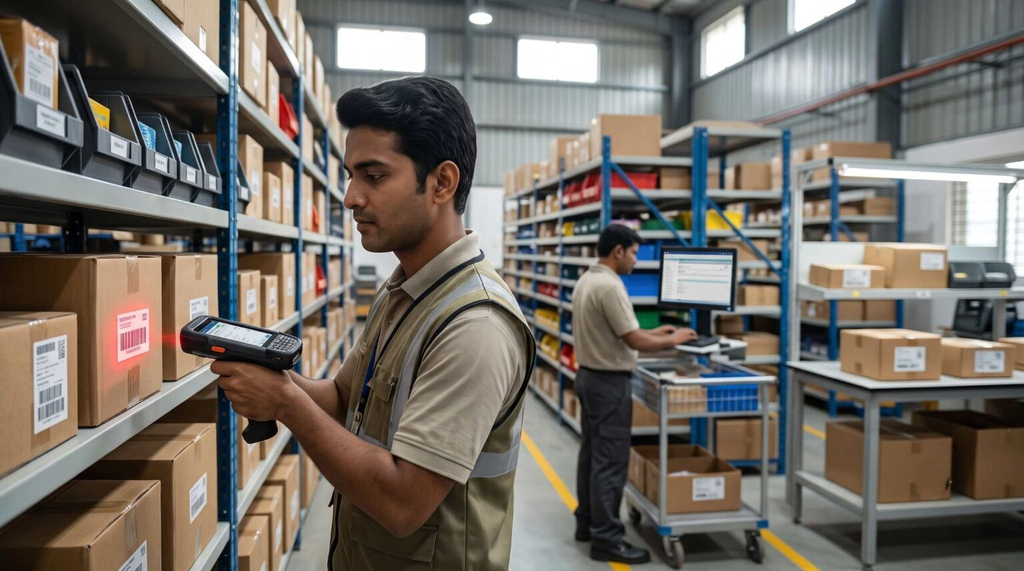
3. Barcode Scanning
Scanning at receiving, putaway, picking and packing confirms that the right item is in the right place. It cuts manual entry mistakes sharply.
4. Inventory Management Systems
These tools show available stock, stock in movement and stock reserved for orders, so that you can plan purchases with confidence.
5. E-commerce Integrations
A connected setup links your Shopify or WooCommerce store, marketplaces, ERP, courier partners and the warehouse. The aim is a smooth path from sale to order to stock to shipment.
Beyond the basics, smart warehouse technology includes handheld scanners, pick-to-light systems, live dashboards and cameras. At the higher end, warehouse automation for e-commerce covers conveyors, sorters, goods-to-person systems and mobile robots. Automated order fulfillment makes sense when volumes are high and steady. For many growing sellers, a good WMS and barcodes deliver more value than robots bought too early.
Why Is Technology Important in E-commerce Warehousing?
Imagine a brand shipping 2,000 orders a month across three marketplaces and its own site. If every order is checked by hand against a spreadsheet, errors are only a matter of time. Now imagine that brand at 10,000 orders a month. Manual tracking no longer just slows things down. It starts to cost real money.
Technology helps with:
- Real-time inventory visibility
- Order synchronisation across channels
- Faster, guided picking
- Fewer manual errors
- Timely replenishment
- Clear order status for customers and support teams
- Reports that show where time and money are going
The biggest gain is that a team can handle more complexity without needing the same increase in manual work.
What Are the Different Types of E-commerce Warehouses?
No single model suits every online business.
1. Private E-commerce Warehouse
You own or lease the building and run it yourself. You get full control, and you also carry the staffing, systems, utilities and maintenance.
2. Shared Warehouse
Several brands use space in the same facility. It suits brands that want flexibility and do not need a dedicated building.
3. 3PL E-commerce Warehouse
A third-party logistics (3PL) warehouse manages storage and fulfillment for you, using its own space, people and systems. You pay for what you use.
4. E-commerce Fulfillment Center
An e-commerce fulfillment center is built around speed of order movement: receiving, picking, packing, dispatch and returns.
5. E-commerce Distribution Center
An e-commerce distribution center moves stock in bulk to regional hubs, stores or other warehouses, and often sits near highways or ports.
6. Specialised Warehouses
Some products need special handling, such as temperature-controlled or cold storage, bonded warehouses, or compliance-approved space for food, pharma and cosmetics.
The right choice depends on your product, order volume, customer locations, sales channels and growth plans.
What Are the Benefits of Using an E-commerce Warehouse?
- Better inventory organisation. Every SKU has a location and a process, so stock is easy to find, count and refill.
- Faster order processing. Standard picking and packing steps mean quicker dispatch and fewer wrong shipments.
- Scalability. Capacity can be raised for festive peaks without rebuilding your own setup.
- Wider reach. Stock placed near big markets improves delivery times and cost.
- Lower operational burden. You spend less time on staffing, space and process headaches.
- Better customer experience. Accurate stock, reliable dispatch and easy returns all build repeat business.
When Should a Brand Outsource E-commerce Warehousing?
There is no single order count that decides this. Look at how complicated your operation has become. Outsourcing deserves a serious look when:
- Your current space is running out.
- Orders are growing quickly.
- You sell on multiple marketplaces.
- Your team spends more time packing than growing the brand.
- Stock errors and wrong shipments are rising.
- You plan to serve new cities or regions.
- Returns are piling up.
- You want warehouse technology without building it yourself.
- Seasonal peaks need extra capacity.
Some brands outsource early to stay asset-light. Others wait until their own space reaches its limit. Both paths are valid.
How Much Does an E-commerce Warehouse Cost?
Cost is the question every founder asks, so here are realistic ranges. These are indicative figures drawn from 2026 information published by Indian 3PL providers and warehousing research. Your actual quote will depend on city, volume, product type and contract terms.
1. Typical 3PL Fulfillment Charges in India
| Service | Indicative Charge |
|---|---|
| Storage | ₹8 to ₹20 per sq ft per month |
| Pick fee (first item) | ₹8 to ₹15 per order |
| Pack fee with basic material | ₹5 to ₹12 per order |
| Additional item pick | ₹3 to ₹6 per extra item |
| Inbound receiving | ₹50 to ₹150 per pallet |
| Returns processing | ₹25 to ₹60 per return |
| All-in handling, excluding shipping | About ₹18 to ₹45 per order |
Some providers quote one bundled per-order fee instead, often between ₹40 and ₹80 for smaller sellers. Shipping is usually billed separately, so compare quotes line by line.
2. Warehouse Space in Ahmedabad
| Space Type | Indicative Rent (per sq ft per month) |
|---|---|
| Grade B or C warehouse | Lower end of ₹15 to ₹25 |
| Grade A modern warehouse | Upper end of ₹15 to ₹25 |
| Popular belts | Changodar, Bavla, Sanand, Aslali, Kheda |
Industry research shows that Ahmedabad warehouse leasing stayed active in the first half of 2026, with steady demand from 3PL and retail users. Confirm current rates with a local broker or owner before you decide. If you are thinking of building instead of renting, read our guide to warehouse construction cost in Ahmedabad.
3. Own Space or 3PL: A Quick Comparison
| Factor | 3PL Warehouse | Own or Leased Warehouse |
|---|---|---|
| Upfront investment | Low | High (space, racks, staff, systems) |
| Cost style | Variable, per order | Mostly fixed |
| Control | Shared | Full |
| Time to start | Quick | Slower |
| Best for | Startups and growing brands | Stable, high-volume sellers |
Some industry sources suggest that a 3PL tends to be cheaper for sellers below a few hundred orders a day, while very high volumes can favour self-operation. Treat that as a guide, not a rule. Product size, return rate and growth plans can change the answer.
How to Choose the Right E-commerce Warehouse
The cheapest option is rarely the best one. Compare providers on these points:
| Factor | Questions to Ask |
|---|---|
| Location | Is it close to my main customer markets? |
| Capacity | Can it hold today’s stock and next year’s? |
| Technology | Does it use a WMS and OMS? |
| Integrations | Can it connect to my website and marketplaces? |
| Fulfillment | How are picking, packing and dispatch handled? |
| Scalability | Can it expand during peak season? |
| Returns | Is reverse logistics supported? |
| Reporting | Will I see stock and order data clearly? |
| Service levels | What delivery and accuracy targets are promised? |
| Special needs | Can it handle my product’s storage rules? |
The right warehouse supports you today without becoming a limit tomorrow.
How E-commerce Warehousing Supports Omnichannel Growth
A single brand may now sell through its own website, Amazon, Flipkart, Myntra, Meesho, quick commerce apps and B2B buyers all at once. If each channel is run separately, stock gets split, errors multiply and teams argue over which numbers are right.
An integrated warehouse acts as the physical base for all of these channels. Inventory, orders, fulfillment and distribution are coordinated in one place. This is where e-commerce logistics management and e-commerce supply chain management meet: you plan purchases, inbound transport, storage and outbound shipping as one connected chain instead of separate tasks.
The last stretch is where customers judge you. Practical last-mile delivery solutions include choosing couriers by pincode performance, keeping stock close to major markets, offering delivery slots and tracking every parcel until it arrives.
E-commerce Warehouse vs. Fulfillment Center: Are They the Same?
People use the two terms interchangeably, but they can mean slightly different things.
An e-commerce warehouse puts more weight on storing and managing the inventory used for online sales. A fulfillment center puts more weight on moving customer orders through picking, packing and dispatch. In real life, most modern facilities do both.
For a growing brand, the useful question is not what the building is called. It is whether it can handle your stock, your orders, your technology and your delivery promises.
E-commerce Warehouse Design and Infrastructure
This is the part we handle every day, and it is easy to underestimate. Your processes can only be as good as the building around them.
E-commerce warehouse design should start from your product mix and order profile, not from a stock drawing. Key points to plan:
- Clear height and column spacing. More clear height means taller racking and more stock per sq ft. PEB structures can deliver wide, column-free spans that keep aisles and packing zones flexible.
- Floor quality. Flat, strong floors protect forklifts and keep pallets stable.
- Dock layout. Enough docks and turning room for trucks prevent queues in peak hours.
- Light and ventilation. Translucent sheets and ridge vents cut heat and electricity use.
- Fire safety. Exits, sprinklers and storage rules should follow the National Building Code and local norms.
- Power and data. Chargers, scanners, CCTV cameras and servers all need dependable supply.
- Room to expand. Keep one side of the plot ready for growth.
Solid e-commerce warehouse infrastructure starts with quality structure steel, correct roofing and a foundation designed for your loads. If you are planning a new building, see our work on Industrial Shed Construction in Ahmedabad, where we design PEB-based warehouse buildings around your storage plan.
Matching Storage to Your Products
| Storage Type | Best For | Main Benefit |
|---|---|---|
| Shelving and bins | Small, light items | Easy piece picking |
| Selective pallet racking | Mixed cartons and bulk SKUs | Direct access to every pallet |
| Mezzanine floors | Fast-moving small items | Adds usable area in the same shed |
| Drive-in or push-back racking | Large volumes of few SKUs | High storage density |
| Controlled-temperature zones | Food, pharma, some cosmetics | Product protection |
How Hindavi Infratech Solution Supports E-commerce Warehouse Growth
We look at a warehouse the way an operator does, then build it the way an engineer should. Before we draw a single column, we ask about your racking, handling equipment, order peaks and expansion plans.
- Needs-based design: structure and layout matched to your storage and dispatch plan.
- PEB and structure steel expertise: fast, efficient buildings with wide clear spans.
- Transparent quotations: itemised scope so that you can compare offers fairly.
- Neat, safe execution: organised site work and clean finishing.
- Support after handover: guidance whenever you want to modify or extend.
We work with brands, 3PL operators and logistics companies who need practical, scalable warehouse construction for online order fulfillment. Our turnkey project solution keeps design, fabrication, civil work and erection under one team.
Frequently Asked Questions About E-commerce Warehouses
What is an e-commerce warehouse?
It is a facility used to store, manage, process and ship products sold through online channels. Its work includes receiving, storage, inventory tracking, picking, packing, dispatch and returns.
How does an e-commerce warehouse work?
It receives stock, stores and tracks it, converts customer orders into pick tasks, packs and labels parcels, hands them to couriers, and processes returns.
What is the difference between an e-commerce warehouse and a normal warehouse?
An e-commerce warehouse is built for frequent, small, SKU-level orders and quick delivery. A traditional warehouse focuses more on storage and bulk distribution.
What technology is used in an e-commerce warehouse?
Common tools include a WMS, an OMS, barcode scanners, inventory software, platform integrations and, at larger scale, automation such as conveyors and robots.
Is an e-commerce warehouse the same as a fulfillment center?
Not always. A warehouse emphasises storing and managing stock, while a fulfillment center emphasises processing orders. Many modern sites do both.
Should small e-commerce brands use a 3PL warehouse?
Often yes, especially if they want to avoid heavy investment in space, staff and systems. The decision depends on volume, product type and growth plans.
Can one warehouse support multiple marketplaces?
Yes. With the right technology and integrations, a single warehouse can serve your website and several marketplaces together.
Can a warehouse be built as a PEB structure?
Yes. PEB buildings are popular for warehouses because they are quick to build, offer wide clear spans and are easy to extend later.
Conclusion
An e-commerce warehouse is the quiet engine behind every online brand. It does far more than store products. It connects inventory, order processing, technology, picking, packing, dispatch, returns and delivery into one dependable flow.
As a brand grows from a single website to marketplaces, quick commerce and B2B, that flow gets more complex. The right warehouse model, backed by the right technology and a well-designed building, stops warehousing from becoming the thing that holds growth back.
If you are planning a new facility or upgrading an existing one, talk to us before you finalise the design. A short conversation about your products, racking and order flow can save months of rework.
One Response